
A document that takes forty minutes to change can quite easily occupy four days.
Not because anyone spends four days working on it. Most of the time nobody is touching it at all. Someone is waiting for a number, somebody else has comments, the person who needs to approve it is in meetings, and by the time the file comes back the next morning another small detail has changed.
This is so ordinary that it barely registers as a delay.
What makes it interesting is that almost every tool involved in the process has become dramatically faster. The file moves instantly. Numbers can be checked in minutes. A new version can be produced almost as soon as somebody asks for it. Large spreadsheets no longer require an afternoon of manual work. Presentations can be rearranged quickly. Text can be rewritten, translated or compared before the meeting that requested it has even finished.
And now, with AI added to the mix, some kinds of work that used to take hours can be done in minutes.
Yet that forty-minute document can still take until Thursday.
We have become very good at shortening the moments when somebody is actually doing the work. I’m less sure we have become equally good at shortening everything that happens around those moments.
Part of the reason may be embarrassingly simple. Whenever we make room, we put something else in it.
If a report that once took two days can now be finished before lunch, nobody expects the person who prepared it to spend the afternoon admiring the efficiency gain. Another task appears. If ten design alternatives can now be produced in the time three used to take, ten alternatives eventually become normal. If information is easier to find, we do not usually decide that we have enough information. We ask for another comparison.
It makes sense in the moment. Why wouldn’t you use the extra capacity?
The complication arrives later, when all of those extra things need somewhere to go.
Ten versions have to be looked at. More information has to be read. More conversations need replies. More open tasks have to be remembered. The time saved at one end quietly reappears somewhere else.
This is particularly obvious when choices are involved.
Three options can be limiting, but at least three options are understandable. You look at them, dislike one, prefer another, argue briefly about the third and eventually choose.
Fifteen options sound better until fifteen options are sitting in front of you.
The layout of one is good, the colour of another is better, a third has an interesting idea that perhaps could be combined with the first. Somebody asks what number seven would look like with the typography from number twelve. And since producing variations is now relatively easy, there is little reason not to see it.
Soon there are eighteen.
Nothing has gone wrong. In fact, a great deal has been produced.
The decision, however, may be almost exactly where it was an hour earlier.
That gap matters because machines and software can increase their output much faster than people can increase their ability to judge it. A system may be able to produce a hundred pages in ten minutes, but the person receiving them has acquired no corresponding ability to read a hundred pages in ten minutes.
The same person still has to decide what matters, what is wrong, what can be ignored and when there is enough.
The amount we can produce has changed much faster than the amount we can meaningfully consider.
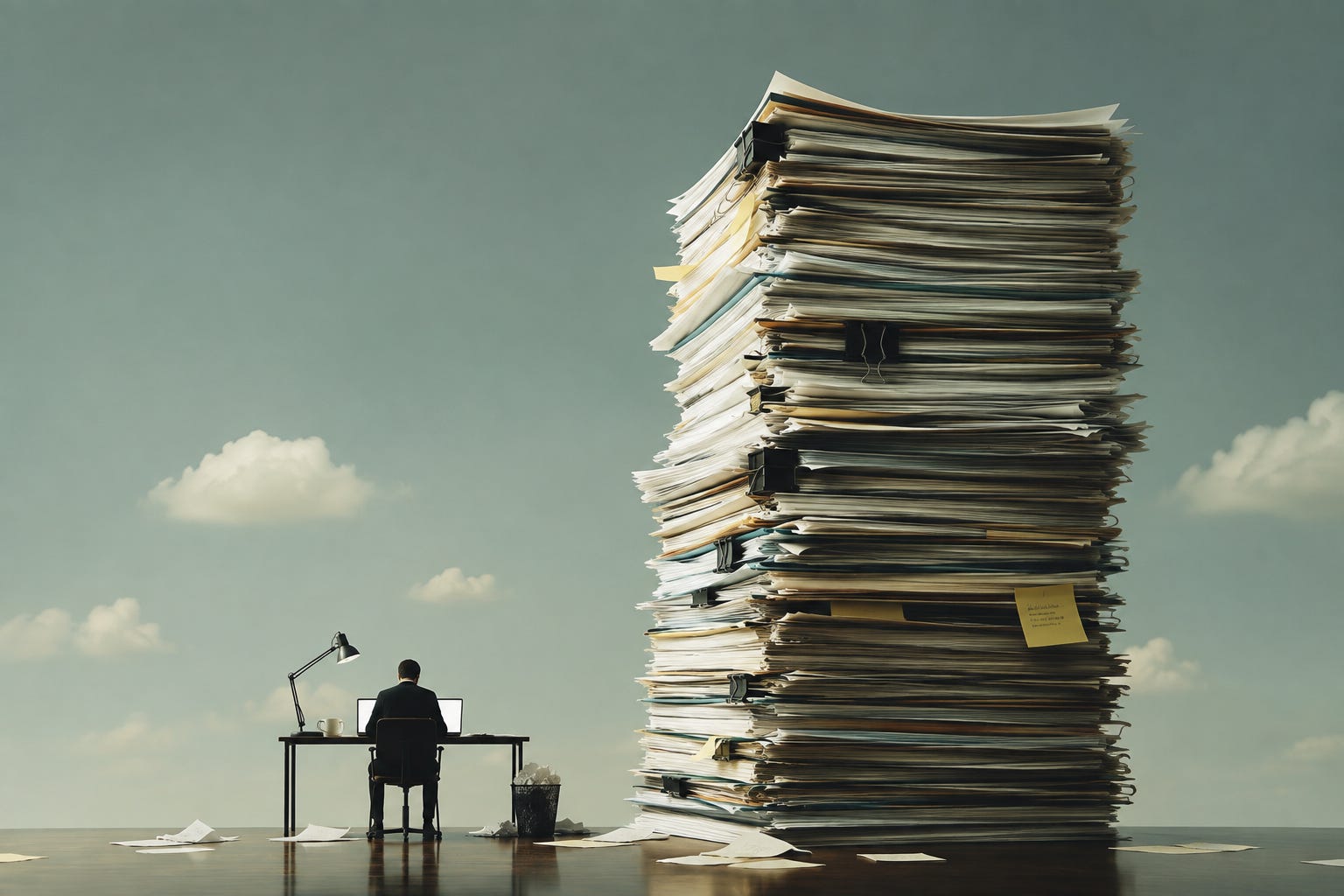
This probably explains some of the peculiar busyness of modern work.
There can be an enormous amount of activity around something without very much happening to the thing itself. A contract is prepared in three hours and waits two days for a response. A drawing is corrected before lunch and approved the following morning. A proposal is complete except for one price that somebody else has to confirm. A meeting ends with agreement that one more person should be asked.
All perfectly normal.
The job remains “in progress.”
What is less visible is how little of that elapsed time contains actual work.
Not every pause is a problem. Some decisions deserve a night’s sleep. People have other responsibilities. Certain information really does have to come from somewhere else. Trying to eliminate every gap would probably create a workplace in which everything happens immediately and half of it has to be corrected the next day.
Still, there is something odd about spending large amounts of money and effort to reduce a two-hour task by twenty minutes while accepting, almost without comment, that the same task may then sit untouched for another forty-eight hours.
The twenty minutes are easy to see. They produce a neat percentage.
The forty-eight hours usually come with a story.
Someone was waiting for someone. The person responsible had another priority. The latest version was not clear. A decision had technically been made but not quite confirmed. The email was seen but not answered. Nobody was sure whether the file really was final.
These are untidy problems, which may be why we prefer measuring the tidy ones.
It is also much easier to count activity. Emails sent, meetings attended, files produced, tickets closed, calls made. By the end of the day there is usually plenty of evidence that everybody has been working.
And they have.
The more interesting measure might be harder to put on a dashboard: how many things disappeared today?
Not deleted. Not forgotten.
Finished.
How many of this morning’s open subjects will not need another email, another meeting, another version or another five minutes tomorrow morning to remember what everyone agreed yesterday?
Because returning to unfinished work has its own cost. A file that comes back after four days does not simply resume where it stopped. Somebody has to remember the context. Which version are we using? What did we decide about that number? Was this comment already resolved? Why was this waiting?
Five minutes here, ten minutes there. None of it looks important.
Across twenty open subjects, it begins to look rather different.
There was a time when starting a piece of work carried a certain cost. A document had to be prepared. Information had to be found. People had to be contacted. Producing another version was enough trouble that you might think twice before asking for one.
Much of that friction has disappeared, which is obviously useful. But friction occasionally did something else too: it discouraged us from opening things casually.
Now a new task costs almost nothing.
Another document? Fine.
Another version? Why not.
Another person in the conversation? Add them.
Another meeting? There is a free slot on Wednesday.
Another comparison? It will only take a few minutes.
Each decision is harmless on its own. Together they create an environment in which starting becomes almost effortless while finishing remains stubbornly dependent on things that have not changed very much.
Somebody still has to choose.
Somebody still has to decide that the information is sufficient, that the slightly better version is not worth another day, that the remaining imperfection can stay, that no further meeting is necessary.
Sometimes the most useful sentence in a project is not particularly sophisticated:
This is good enough. Send it.
There is no obvious technology that makes saying that sentence twice as easy.
Perhaps that is why faster tools have not produced the spacious working days we once imagined they might. We saved time, then immediately found new uses for it. We increased capacity and increased the number of things flowing through it. The desk did not empty. It simply learned to hold more.
By Friday afternoon, quite a lot may genuinely have happened.
Files have been revised, sent and returned. Decisions have moved forward. New work has appeared that did not exist on Monday. Everyone is tired for perfectly legitimate reasons.
Then, just before closing the laptop, there is usually one document still sitting there.
Its filename contains FINAL.
Next to it is FINAL 2.
Follow on:
Substack | LinkedIn | Instagram | Threads | X | Reddit | Facebook | Bluesky | NSosyal | Mastodon
When humanity forgets how to feel, what is eternity for?
A dystopian science fiction novel about memory, identity, emotional suppression, and the cost of engineered perfection.
In a future where pain has been controlled, fear has been softened, and human emotion has been quietly redesigned in the name of order, one awakening begins to expose the truth hidden beneath the system.
ENGLISH VERSION
Amazon Kindle | Kobo | Google Books | Gumroad
TÜRKÇE VERSİYONU