
Tell someone you have started running and it is surprisingly difficult for the conversation to end with a simple “nice.” How far do you run? What is your pace? Which shoes did you buy? Are you training for a race? If you enjoy photography, someone will ask what camera you use. Develop even a mild interest in coffee and, before long, you may find yourself running a small technical department involving grinders, beans, ratios and water temperature.
The funny thing is that we enter all of this quite willingly. Curiosity is a good thing. So is the satisfaction of getting better at something. Somewhere along the way, though, we seem to have lost the ability to leave the things we enjoy alone.
“I run because I like it” now feels slightly incomplete. It seems to require a second sentence. I want to get faster. I am preparing for a half marathon. I want to lose a certain amount of weight. Make pottery a few times and there is a second-level course waiting. Pick up a guitar and there are more songs to learn. Take photographs for a while and, naturally, the photographs ought to improve.
Nobody is explicitly demanding any of this. Still, admitting that you have been doing something for three years and remain thoroughly average at it can produce a faint sense that an explanation is required.
I do not think being average is the strange part.
The strange part is how accustomed we have become to the idea that everything must eventually lead somewhere.
We managed to turn hobbies into work too
A large enough part of adult life is already organised around improvement. We are expected to get better at our jobs, solve problems faster and live with the consequences of our decisions. Much of the day is spent catching up, fixing something or getting something finished.
The nice thing about hobbies used to be that they largely escaped all of that.
Nobody expected a measurable performance improvement while you played guitar in the evening. The cake you baked on Sunday did not need to be twelve per cent better than last month’s. You went for a bicycle ride, came home and that was the end of the activity. No report followed.
Now we have built a small management system around our free time as well.
We log our runs, score our sleep, count our steps and track how many books we read in a year. Sometimes it becomes difficult to tell whether we enjoy reading books or enjoy reaching the number we decided we should have read by the end of December.
And the moment we try something new, the best people in the world at that very thing are already waiting in our pockets. You bake your first loaf of bread and five minutes later you are watching someone discuss the structure of a crust as though it were an engineering problem. You play tennis for the third time, go home and watch a professional serve in slow motion. You take a few photographs, then look at the work of someone who has spent a lifetime waiting for exactly the right light.
What you made starts to look a little pathetic.
Of course it does. We are comparing someone else’s destination after years of practice with our fourth attempt. More importantly, most of the time nobody invited us to compete in the first place.
We entered the competition ourselves.
At some point, that changes the pleasure of the thing. Instead of being inside the activity, we step outside it and begin evaluating it. Am I any good? Am I improving? Did I buy the right equipment? Should I take this more seriously?
One of the least pleasant things that can happen to a hobby, I suspect, is being taken too seriously.
Children seem considerably more relaxed about this. A person in their drawing can have one arm twice the length of the other and the picture is still perfectly finished. They can sing half the lyrics incorrectly and sing the same song again the next day. Missing the ball does not immediately become evidence that perhaps ball games are simply not for them.
As we grow up, we do not only acquire skills. We also become much more aware of how we look while using them.
Eventually, we begin spending less time on the things we are bad at.
There is some logic to that. Life is short and days are full, so naturally we move towards the things we do well. But in the process, we quietly lose another category of experience: things whose outcome we barely care about.
The things we are good at acquire weight over time. We develop standards. Sometimes other people develop expectations too. When the result is poor, it bothers us.
Something we are bad at expects very little.
You hit the tennis ball out and another one arrives. You play the wrong note on the piano and the planet continues to rotate. The mug you made in pottery is slightly crooked; coffee still goes inside it.
That kind of freedom should not be underestimated.
A few hours in which you are not required to be good at anything is a fairly decent arrangement in adult life.
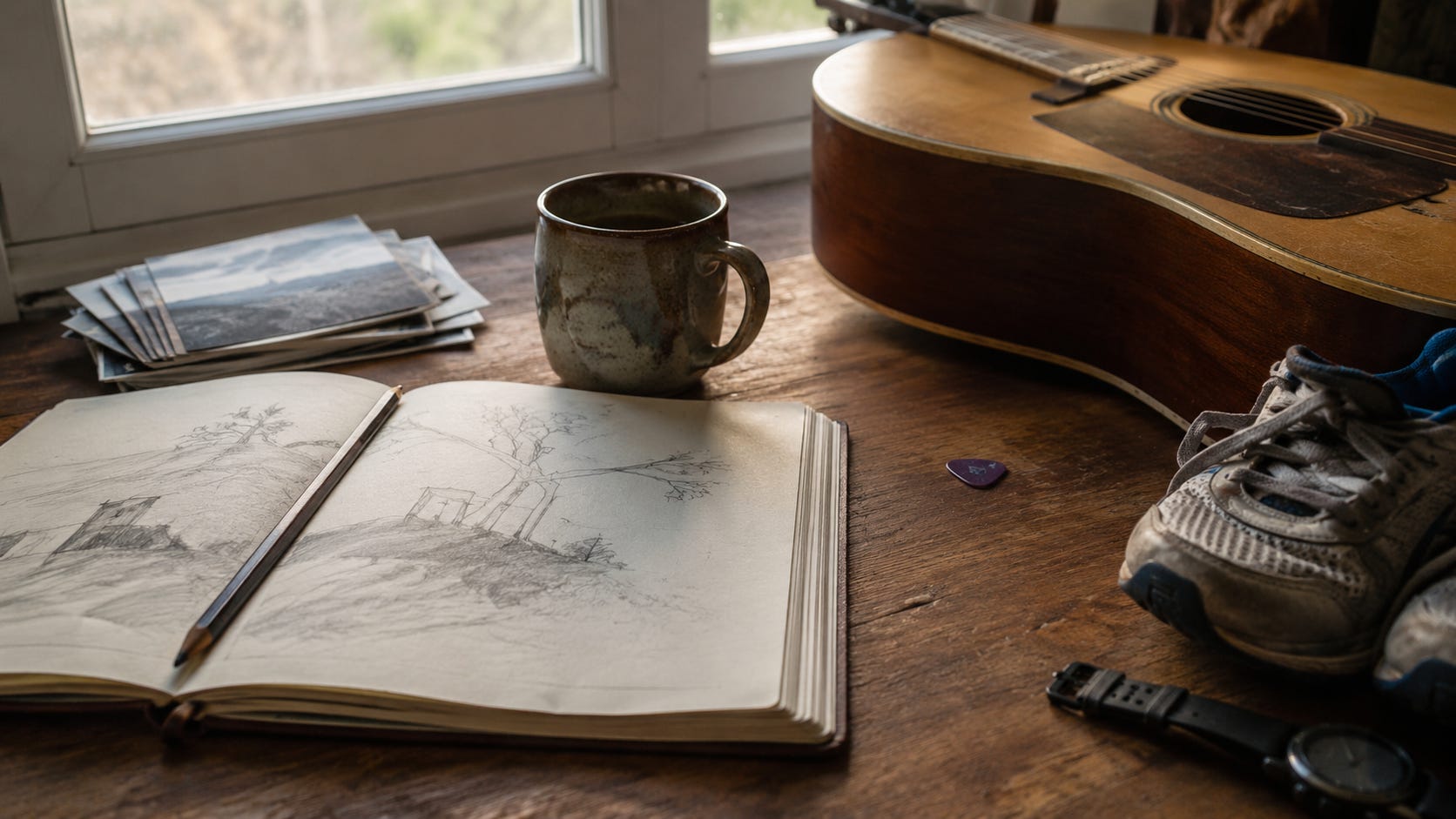
Let some things remain unseen
There is another part of this that I find interesting.
It has become harder for the things we do to remain without an audience.
We make a good meal and photograph it. We learn something and want to share it. We go somewhere and a record of it remains. I do not think all of this is vanity; sharing something can genuinely be enjoyable. But another habit has appeared alongside it: we sometimes behave as though an experience is not quite complete until somebody else has seen a little of it.
It may not be a bad idea to keep a few things in life that nobody else will ever see.
A song you play badly enough that nobody needs to hear it. Photographs that will never be uploaded anywhere. A meal that looks hopeless but tastes perfectly good. A walk whose distance means absolutely nothing to anyone.
None of these things need future potential.
Playing guitar may never lead to a stage. Taking photographs may never become an account. Your drawings may still not deserve wall space years from now. Your tennis serve may remain unreliable for the rest of your life.
So what?
For a hobby to fail, there first has to be some form of success it was supposed to achieve.
Sometimes there simply isn’t one.
Sometimes the entire purpose of doing something is that you enjoy yourself while doing it. After spending an hour pleasantly, demanding that the hour also produce some other benefit begins to feel slightly greedy.
Not everything has to give us something. Some things are allowed to do nothing more than help us spend our time well.
I think that becomes more valuable in adulthood than we tend to admit.
For the rest of the day, there are already enough things we need to take seriously. We should do our jobs well, keep our word, meet our responsibilities and, in certain areas, genuinely know what we are doing.
There is no great harm in remaining incompetent in a few corners of life.
We can play the same five songs for three years. Our mugs can stay slightly crooked. Our running pace may never improve. And we do not owe anyone an explanation for any of it.
Perhaps the most comfortable way to love something begins right there:
when we stop wondering what we are going to do with it.
Follow on:
Substack | LinkedIn | Instagram | Threads | X | Reddit | Facebook | Bluesky | NSosyal | Mastodon

When humanity forgets how to feel, what is eternity for
When humanity forgets how to feel, what is eternity for?
A dystopian science fiction novel about memory, identity, emotional suppression, and the cost of engineered perfection.
In a future where pain has been controlled, fear has been softened, and human emotion has been quietly redesigned in the name of order, one awakening begins to expose the truth hidden beneath the system.
ENGLISH VERSION
Amazon Kindle | Kobo | Google Books | Gumroad
TÜRKÇE VERSİYONU