
07:18 — The Entrance
I don’t think a robot will be waiting outside the door when we leave home on an ordinary morning in 2030.
We’ll probably still check for our phone, wallet and keys. We may still manage to leave one of them inside. The building itself might not look very different either.
The changes will be easier to spot once you step inside.
The front door will still be a door, but it may also be part of a wider access system deciding who can enter and when. The cabinets beside it may no longer be simple mailboxes; groceries, parcels and other deliveries could be waiting there. The lift will still move between floors, while quietly reporting maintenance needs, managing access and taking its place inside the building’s energy system.
None of this is the kind of thing that makes you call a friend and say, “I’ve seen the future.”
That may be precisely the point.
Most buildings going up today will still be relatively new in 2030. Cars bought now will still be on the road. The tables, sofas and kitchens in our homes are unlikely to disappear just because the calendar changes.
The world is not going to change its décor overnight.
What happens behind it may be another matter.
07:46 — The Car Park
The car is sitting where you left it.
Four wheels, steering wheel, seats. Reassuringly, it still looks like a car.
But it may not have spent the night simply parked.
As electric vehicles become more common, the car is also becoming a very large battery that happens to move around. In systems already being tested today, electricity does not only travel into the vehicle. It can travel back out again, supplying a home or returning power to the grid when needed.
At that point, deciding exactly what business the car belongs to becomes less obvious.
Automotive?
Energy?
Software?
Those categories used to be comfortable. The utility generated electricity. The car company made cars. The home consumed power. The filling station supplied the vehicle.
Now a home can generate electricity, a car can store it, and a building can decide when it makes sense to consume or hold some of it.
None of these changes looks especially dramatic on its own.
Put them together and the old categories start to become a little uncomfortable.
10:35 — The Desk
It would be strange to talk about 2030 without mentioning AI.
But by then, the interesting part may not be a separate box on a screen labelled AI.
Today we deliberately open a tool and ask it to summarise something, prepare a draft or compare two documents. If those functions become part of the software we already use, we may stop thinking about them as separate activities at all.
Email will suggest or prepare replies. A calendar will do more than show a conflict; it may resolve one. Accounting software will notice an unusual invoice before anyone goes looking for it. Design software will generate alternatives as part of the normal process.
What changes here is not necessarily how much software we use.
It is where the software sits in the work.
Most of the tools we use today help us do something.
More of them will begin doing part of it themselves.
That sounds like a small distinction until you consider what it does to a working day. If your job is to produce everything yourself, you spend your time one way. If a system produces part of it for you, more of your time moves towards judging, checking, correcting and deciding.
The desk may look exactly the same. The job being done at it may not.
13:20 — The Shop
You walk into a shop after lunch.
There are shelves. Products. Someone is there to help.
It still looks like a shop.
But the thing you see and the thing you eventually buy no longer need to be in the same place.
Furniture already works this way. You sit on a sofa, feel the fabric, check the size, then order a colour that is not in the building. The product delivered to your home may come from a warehouse somewhere else, or may not even have been made yet when you sat down.
Cars increasingly work this way too. Electronics as well.
The physical shop is not disappearing.
Its job is becoming less obvious.
A shop used to be, above all, the place where the product was.
Now the same space may be there to let you see it, try it, understand it, trust it, order it, arrange delivery and later return for service.
Retail begins to overlap with logistics. Sales begins to overlap with service. The online order and the physical visit stop looking like two separate ways of shopping and start looking more like different moments in the same purchase.
By 2030, perhaps the interesting question will not be whether there are fewer shops.
It may be whether the word shop still describes quite the same thing.
18:55 — Back Home
I hope the home of 2030 looks very little like the “smart home” demonstrations we have been shown for years.
Nobody wants to come through the door and choose between twelve lighting scenes. I’m also not convinced that the refrigerator urgently needs to develop a personality.
Technology tends to become more useful when we stop noticing it.
The heat pump is running. Solar panels are producing electricity. A home battery, if there is one, charges when it makes sense. The car is plugged in downstairs. If electricity prices change during the day, some devices may adjust without requiring a family meeting.
If the person living there has to sit in front of a dashboard behaving like the operator of a small power station, something has probably gone wrong.
The interesting change is what this does to the idea of the home itself.
For most of its history, the modern home has been the end of the energy chain. Electricity arrives and gets used.
That is already becoming less straightforward.
The same address can produce, store and consume power, and in some cases send it back out again.
It is still a home.
From the point of view of the energy system, however, it is no longer necessarily a passive endpoint.
22:40 — The Phone
At the end of the day, the phone is still in your hand.
It may even remain a rectangular piece of glass.
One mildly disappointing thing about 2030 may be how familiar some of its objects look.
What changes is the amount of work hidden inside them.
The phone is already a camera, wallet, map, screen and communications device. Over the next few years, more identity, access and approval will probably gather in the same place.
It opens the door.
Recognises the car.
Approves the payment.
Carries a travel credential.
Confirms that the person connecting to a service is actually you.
Paradoxically, the phone may become more important while requiring less visible attention.
That tends to be what happens when technology matures.
At first, it demands to be noticed.
Later, if it is any good, it disappears into ordinary life.
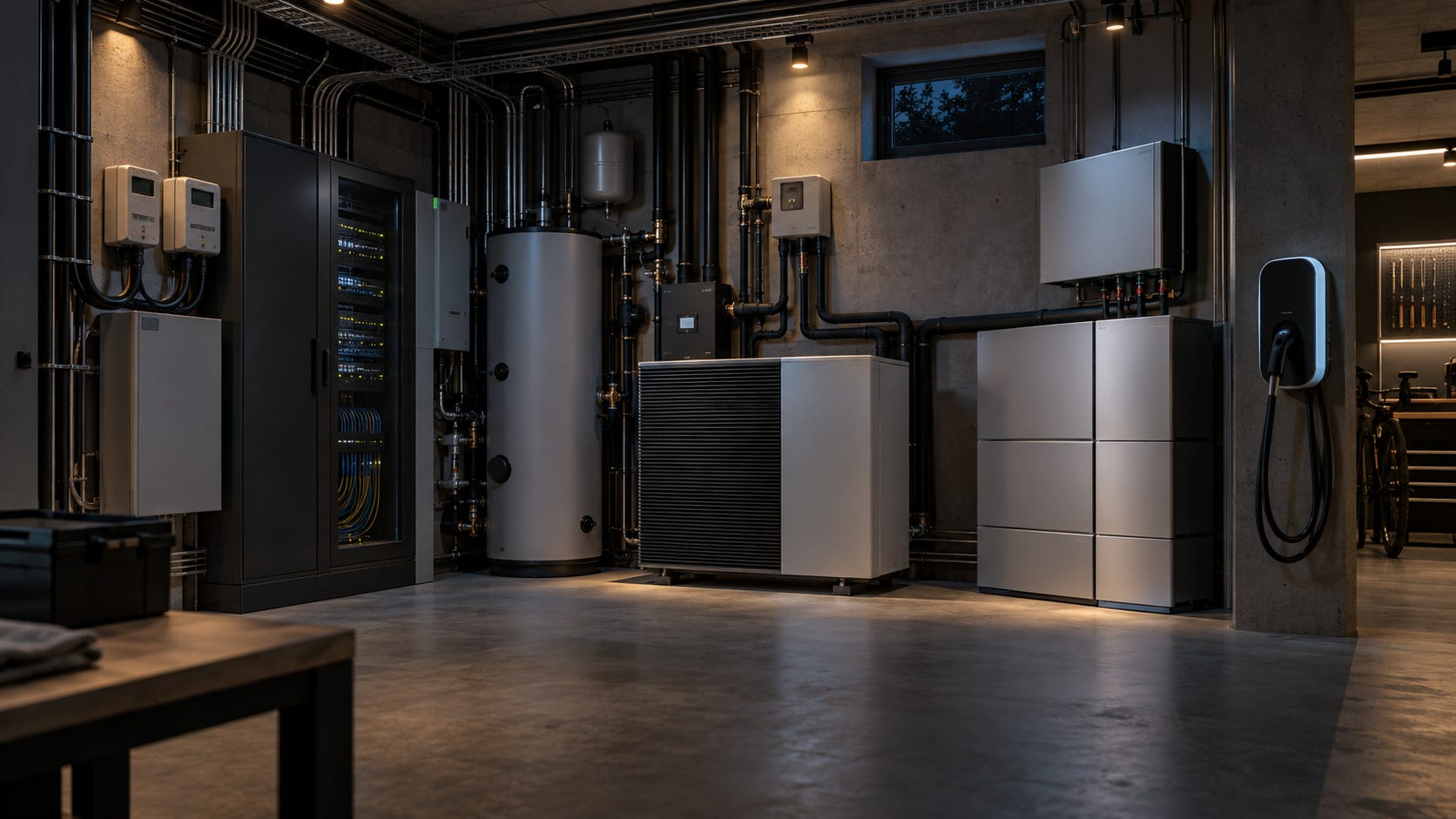
23:16 — The Basement
This may be where most of 2030 is hiding.
The basement.
Pipes, cables, electrical panels, pumps and meters. Perhaps a battery system. Heat-pump equipment. Fibre. Charging infrastructure.
Hardly anyone wants a tour.
Upstairs, life looks completely ordinary.
Someone is watching television. A child is asleep. A car is charging downstairs. A parcel is sitting in a locker until morning. One apartment is producing a little electricity while another is consuming it. Data is moving through the building. The heating system is doing whatever it needs to do.
Underneath all of that, industries we have spent decades thinking about separately are beginning to occupy the same physical space.
Energy.
Transport.
Communications.
Retail.
Security.
Work.
On paper, their boundaries still look fairly clear.
In daily life, they may not remain so.
By the time 2030 arrives, we may walk outside and recognise almost everything around us.
The same apartment block.
Cars that still look like cars.
Familiar shops.
A phone in our pocket.
We will already know what these things are.
The harder question may be:
What do they do now?
Follow on:
Substack | LinkedIn | Instagram | Threads | X | Reddit | Facebook | Bluesky | NSosyal | Mastodon

When humanity forgets how to feel, what is eternity for?
A dystopian science fiction novel about memory, identity, emotional suppression, and the cost of engineered perfection.
In a future where pain has been controlled, fear has been softened, and human emotion has been quietly redesigned in the name of order, one awakening begins to expose the truth hidden beneath the system.
ENGLISH VERSION
Amazon Kindle | Kobo | Google Books | Gumroad
TÜRKÇE VERSİYONU