
Waking up in a hotel room and needing a few seconds to remember where you are is normal. Especially if you travel often.
Sometimes, though, it isn’t because you’re still half asleep.
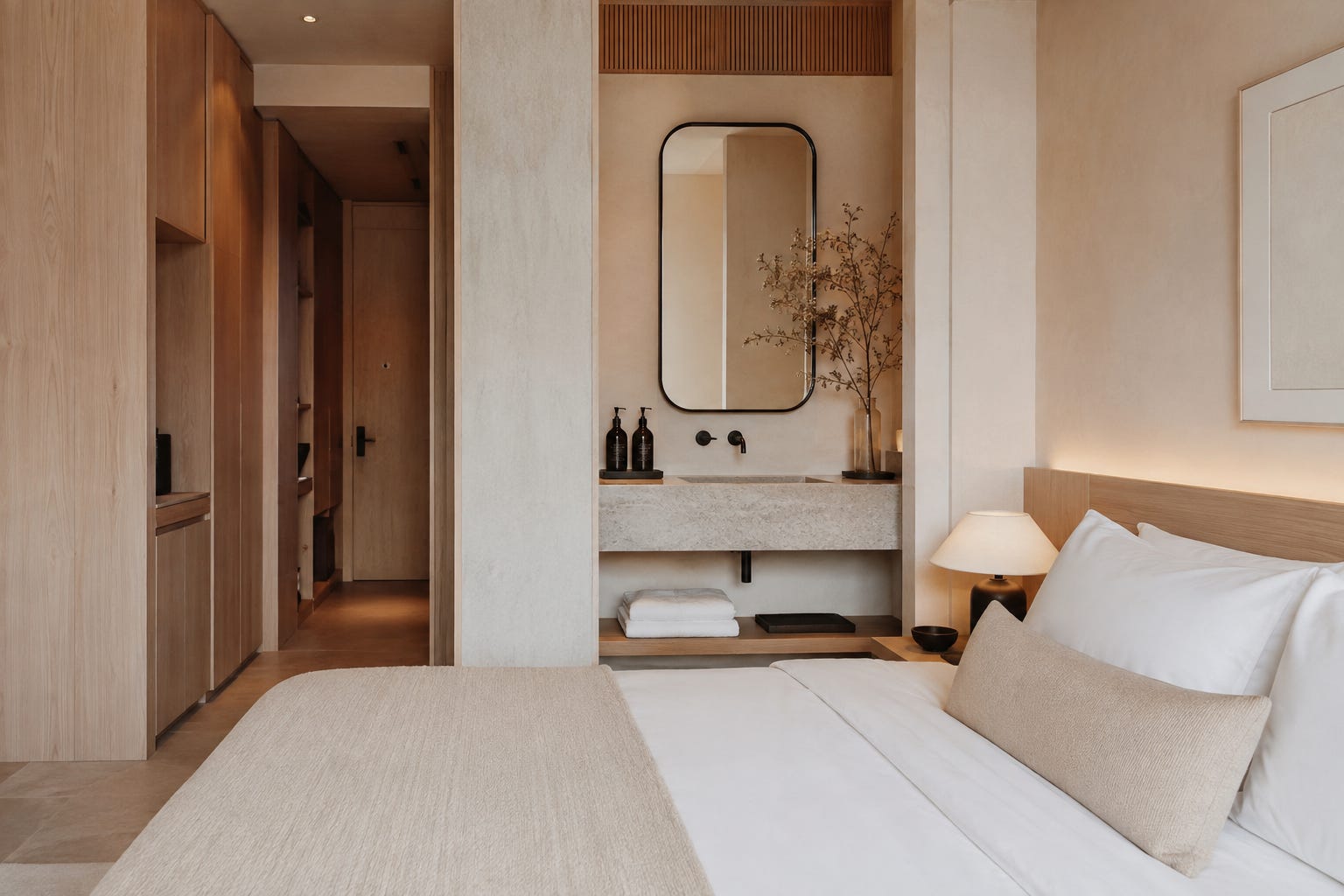
You look around the room: pale wood, neutral bedding, a thin black-framed mirror, a small lamp beside the bed. Dark pump bottles in the bathroom. A few dried branches in the corner that, as far as I can tell, serve no particular purpose.
Without looking out the window, it would be difficult to guess which country you’re in.
The same thing happens in cafés. A few large plants, rounded chairs, matte ceramic cups, a deliberately short menu. The coffee is good. The music doesn’t bother you. The tables are nice. Even the little sign on the bathroom door appears to have been carefully chosen.
Nothing has been done badly.
Quite the opposite. Everything is very good.
And yet you are fairly sure you have been here before. You just can’t remember in which city.
Was it Sarajevo? Tirana? Istanbul? London? After a while, it almost stops mattering. They aren’t the same places, of course, but they are clearly related.
And it isn’t only cafés and hotels. The same sense of familiarity is turning up in new restaurants, apartment buildings, shops, offices and homes.
We have more choices than ever before.
Strangely, the more choices we have, the more similar the results seem to become.
Nobody Chooses Bad Taste on Purpose
It isn’t difficult to see how this happens.
If you’re opening a café, you choose things you already know people tend to like. If you’re designing a hotel, you probably don’t want guests to walk into the room and say, “Well, this is a bit strange.” If you’re trying to sell an apartment, highly personal choices are usually less useful than ones that appeal to a wider group of people.
All perfectly reasonable.
And good examples are now incredibly easy to find. The interior of a tiny restaurant in Tokyo can be sitting on a designer’s phone on the other side of the world that same afternoon. A bathroom in a Copenhagen hotel gets saved for reference. The lighting in a Madrid café becomes inspiration for another project somewhere else.
Then that project goes online too.
Nobody necessarily copies anyone directly. Most of the time they probably don’t.
But if everyone is looking at roughly the same things, we can take very different roads and still end up at the same junction.
What interests me isn’t bad design. Bad design is easy. You dislike it and move on.
The more interesting thing is safe good taste.
Colours that offend nobody. Materials that photograph well. Furniture that is unlikely to look dated in three years. Details that are neither too bold nor too cheap-looking.
Everything is right.
Sometimes so right that there is very little left to remember.
You notice this most clearly when an old place sits next to a new one. A neighbourhood restaurant that has been there for decades may have chairs from three different eras. The sign might be slightly too large. The lighting is probably the first thing a contemporary interior designer would change. There may be a painting on the wall that nobody can quite explain anymore.
And five years later, that may be exactly what you remember about the place.
A newly opened restaurant, meanwhile, has chairs that match the tables, tables that match the walls, walls that match the logo, and a logo that matches the menu. Even the staff aprons look as though they were selected from the same colour palette.
It is difficult to object. It looks good.
But for some reason, that ridiculous painting in the old restaurant stays in your head longer.
I suspect part of the reason is that older places were rarely designed all at once. Someone put something there. Years later someone else added something else. A third owner changed a few things and left the rest alone.
The place accumulated time.
Many new places, by contrast, want to look finished on the day they open. From the first morning, they already seem to know exactly what they are supposed to look like.
We Are Also Getting Harder to Surprise
Restaurants have another version of the same problem.
When you arrive in a new city and sit down at a good restaurant, it is harder than it used to be to encounter something completely unfamiliar. Similar ingredients, familiar cooking techniques and recognisable styles of presentation have travelled remarkably well.
Mostly, this is a good thing. You no longer have to gamble quite so much on dinner after arriving somewhere late in the evening.
Then again, many of the meals we remember from travelling were a bit of a gamble.
The evenings when you couldn’t quite understand the menu, asked the waiter, were told to order something else, and then received a plate that looked nothing like what you had expected.
Sometimes it was excellent.
Sometimes it wasn’t.
You forgot the second kind a few days later.
We are much better protected from bad surprises now, but along the way we have also removed some of the accidents. Before going somewhere, we can see the menu, look through photographs, read what people ordered and know which table has the best view.
Sometimes we know so much about a place before arriving that all that remains is to confirm it.
That doesn’t make travelling worse.
It just makes it a little more familiar.
You can see something similar in homes. Scroll through new apartment listings in different countries and, every now and then, it feels as though the same living room has simply been given windows overlooking different cities. Large pale sofa, wood surfaces, thin black details, round mirror, a few carefully placed objects.
Again, none of this is bad.
There is a reason many of us like these things: they look good.
But homes used to be places that became slightly ruined over time. A chair inherited from the family that matched absolutely nothing else would stay. Some object bought on a trip, whose purchase was difficult to justify years later, remained on a shelf. A table you couldn’t quite bring yourself to throw away carried on living among the newer furniture.
An interior designer might have identified several problems.
The person living there probably didn’t.
Because you could tell, at least a little, who the home belonged to.
In some beautifully finished homes today, remove the personal belongings and there is surprisingly little left to tell you who actually lives there.
We have become extremely good at finding things that look good.
Perhaps what has become harder is telling the difference between something we like and something that is actually ours.
I Don’t Want Everything to Stay Old
It would be easy to turn all of this into an argument that old places had character and new ones have none.
I don’t believe that.
Plenty of old hotels had genuinely terrible bathrooms. An uncomfortable chair that has been sitting in the same restaurant for thirty years isn’t necessarily “full of character.” Being local does not make bad service charming.
Better design, better hygiene, more comfortable spaces and the fact that places can learn from one another have made everyday life noticeably better.
That isn’t the problem.
The odd thing is something else:
Why does a place so often begin to resemble other places as it improves?
Can a café be contemporary and still keep some of the peculiarities of the street outside? Can a hotel be comfortable and leave you one small clue that tells you what city you’re in? Can a home look good and still tolerate a few questionable decisions made by the person who lives there?
I think it can.
After all, the things we tell people about places years later are rarely their perfection.
I don’t hear many travel stories beginning with, “The mattress had exactly the right level of firmness.”
We talk about the little restaurant around the corner, the strange owner, the old sign, the sound coming through the window in the morning, the thing we ate without being entirely sure what it was.
Good coffee is available in a lot of cities now. So are comfortable beds, beautiful bathrooms and decent food.
They matter. They just aren’t rare anymore.
What is becoming rarer is the feeling that the place you’re standing in could not quite exist anywhere else.
Maybe that’s why, when we return to a city, we don’t always check on the newest and most polished places first.
We wonder about the old ones.
Did they change the sign?
Is the same man still behind the counter?
Did they finally take down that ridiculous painting?
I hope they didn’t.
Follow on:
Substack | LinkedIn | Instagram | Threads | X | Reddit | Facebook | Bluesky | NSosyal | Mastodon

When humanity forgets how to feel, what is eternity for?
A dystopian science fiction novel about memory, identity, emotional suppression, and the cost of engineered perfection.
In a future where pain has been controlled, fear has been softened, and human emotion has been quietly redesigned in the name of order, one awakening begins to expose the truth hidden beneath the system.
ENGLISH VERSION
Amazon Kindle | Kobo | Google Books | Gumroad
TÜRKÇE VERSİYONU